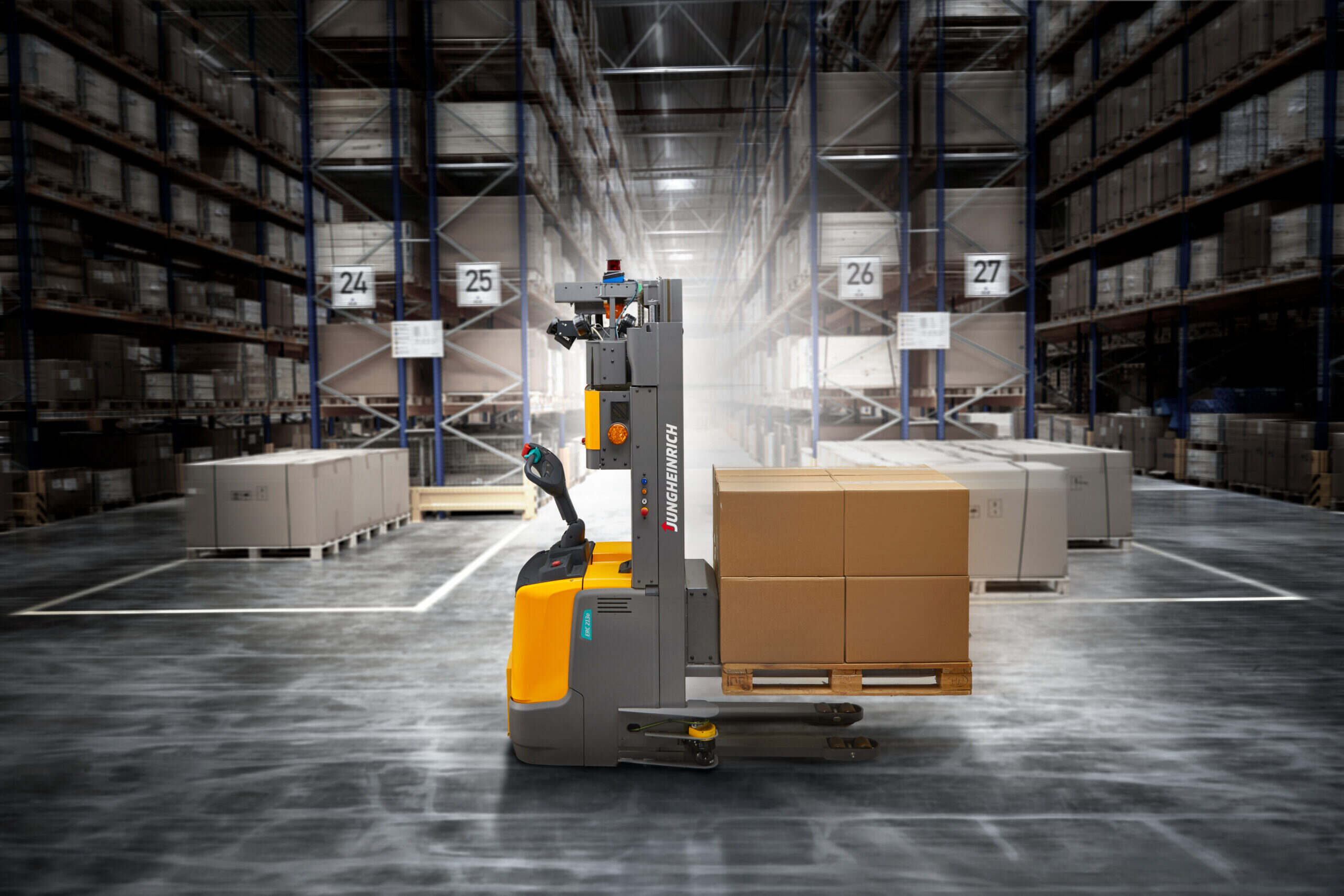
Safe Pallet Handling Practices
Safety depends on consistent technique, well-trained operators, and routine inspections. Strong fundamentals in manual lifting, powered equipment use, and load stability help prevent injuries and product damage. Establishing clear rules for pallet handling ensures that safe methods are repeatable from shift to shift.
Safe use of pallet trucks and forklifts
With manual pallet jacks, center the forks under the pallet, balance the load, and test lift slightly to confirm stability. Move at controlled speeds, look ahead, and keep both hands on the handle. On inclines, travel with the load uphill to maintain control. For forklifts, approach the pallet squarely, set forks to the widest safe spacing, and fully insert the forks before lifting. Slightly tilt the mast back to secure the load and keep forks just high enough to clear the floor. Maintain safe speeds, sound the horn at intersections, and ensure clear visibility; when the load blocks your view, travel in reverse when it is safe to do so. Never lift or carry people on forks or attachments not designed for personnel.
Balancing loads and travel best practices
Build stable unit loads by stacking heavier items on the bottom and maintaining a low, centered center of gravity. Avoid product overhang beyond the pallet edge unless packaging is designed for it. Use stretch wrap, corner boards, or straps to prevent shifting. Maintain aisle clearance, follow floor markings, and keep a safe following distance. Stop before turning—especially with high or tall loads—to reduce tipping risk.
Pallet inspection and retirement criteria
Inspect pallets before each use. Remove from service any pallet with broken or missing deck boards, split or crushed stringers, protruding fasteners, rot, oil saturation, delamination (on composite pallets), crushed blocks, severe warping, or rack damage. If a pallet cannot safely carry its rated load or seat properly in racking, retire it immediately. Mark unsafe pallets clearly and place them in a designated quarantine area for repair or disposal.
Pallet Handling Methods and Equipment
Choose handling methods based on volume, load characteristics, travel distances, and labor availability. Combining manual and mechanical options reduces touches, lowers injury risk, and improves throughput. A balanced pallet handling strategy blends flexibility with standardisation so operators can adapt while following clear rules.
Manual vs. mechanical handling
Manual handling—hand carries, team lifts, and manual pallet jacks—fits short distances, stable loads, and low-volume operations. It is flexible and has low capital cost, but it can be slower and carries higher ergonomic risk. Mechanical handling—powered pallet trucks, stackers, forklifts, conveyors, and automated systems—supports heavier loads, longer travel, and higher volumes with less strain and greater consistency. It requires training, power or fuel infrastructure, and maintenance. Use manual methods when moves are infrequent and loads are manageable. Shift to mechanical solutions when throughput, travel distance, or load weight makes manual handling unsafe or too slow.
Common equipment and their roles
- Pallet jacks: Ideal for short moves on smooth, level floors. Manual jacks are affordable and maneuverable; powered jacks handle heavier loads and longer distances with less fatigue.
- Stackers: A mid-range solution between pallet jacks and forklifts. They lift to moderate rack heights, work in tighter aisles, and are best for lighter loads and short putaway and retrieval tasks.
- Forklifts: The primary workhorse for receiving, putaway, replenishment, and shipping. Counterbalance trucks handle dock work and floor stacking; reach and deep-reach trucks serve high-bay racking; narrow aisle trucks support tight layouts.
- Conveyors: Move palletized loads between fixed points to reduce travel time and congestion. Gravity and powered options feed docks, staging lanes, and buffer areas.
Each tool contributes to reducing manual touches and standardizing flow, helping you move pallets efficiently and safely.
Ergonomics and productivity
Design your layout to minimize travel, reduce turns, and simplify task flow. Place fast-moving SKUs near docks and forward pick faces. Keep aisles clear and sized for the equipment you operate. Position workstations at waist height, use anti-fatigue mats, and rotate tasks to minimize repetitive strain. Implement flow-through rack and pallet flow lanes to reduce double handling. Standardize pick and putaway paths, designate one-way traffic where possible, and add visual cues at stops and intersections. Good lighting, clean floors, and clear sightlines at crosswalks support both speed and safety.
Pallet Management and Maintenance
Strong pallet management reduces damage, protects product quality, and keeps operations audit-ready. Selecting the right pallet for your environment and maintaining it properly has a measurable impact on cost and safety.
Pallet types and selection criteria
- Material: Wood pallets are versatile and repairable, suitable for general use. Plastic pallets provide consistent dimensions, moisture resistance, and easy sanitation, often favored in food and pharmaceutical operations. Metal pallets deliver durability for harsh environments and heavy-duty loads. Composite or pressed pallets are often lightweight and nestable, making them useful for export.
- Size: Common sizes include 48×40 inches (GMA standard) in the United States, with half and quarter pallets used in retail. Match pallet size to racking, dock plates, and trailers to avoid overhang and compatibility problems.
- Load capacity: Consider static, dynamic, and racking loads. Confirm the pallet’s rating against the heaviest expected unit load, including packaging and dunnage. For selective rack, ensure the pallet supports point loads on beams without deflection that compromises fork entry or product safety.
- Environment: In cold storage, choose materials and coatings that tolerate low temperatures without becoming brittle. In clean rooms or washdown areas, select non-porous pallets that resist water and chemicals. For export, comply with heat-treated wood standards and verify destination country regulations.
Inspection, repair, and cleaning
Set a routine inspection cadence: at receiving, before loading, and upon return from production or outbound staging. Repair wooden pallets by replacing broken deck boards, reinforcing stringers with plugs or companion boards, and ensuring fasteners are flush. Only trained personnel should perform repairs to a defined standard so that load ratings remain reliable. Clean pallets regularly, especially in food, beverage, and pharmaceutical operations. Remove debris, nails, and splinters; wash plastic pallets with approved detergents; and allow full drying before reuse. Document inspections and repairs to track pallet condition and identify recurring issues.
Storage and stacking guidelines
In racking: Ensure proper beam spacing and pallet support. Use wire decking or pallet supports where needed, especially for non-structural or suspect pallets awaiting repair. Never rack a loaded pallet that is damaged. Keep pallets fully seated with even weight distribution and adequate clearance for safe retrieval.
Floor stacking: Stack on a flat, clean surface. Align stacks vertically, keep the heaviest stacks on the bottom, and limit stack height based on pallet type and load stability. Use interlocking patterns only when packaging allows. Otherwise, column stacking with proper wrap maintains vertical strength.
Environmental controls: Keep storage areas dry and well-ventilated. Protect pallets from standing water, extreme heat, and prolonged UV exposure that can degrade materials. Maintain required clearances around sprinklers and mark buffer zones to support fire protection.
Optimizing Pallet Flow Across the Facility
Beyond individual tasks, a facility-wide view of pallet movement helps reduce handling and congestion. Mapping flows from receiving to putaway, replenishment, picking, staging, and shipping reveals opportunities to streamline paths and standardize processes.
- Use dedicated inbound and outbound lanes to prevent cross-traffic.
- Right-size staging areas near docks to minimize last-minute reshuffling.
- Adopt first-in, first-out (FIFO) or first-expired, first-out (FEFO) sequencing where required to maintain product integrity.
- Leverage pallet ID tags, barcodes, or RFID to track condition and movement.
- Implement exception lanes for damaged pallets or overdimension loads to keep main lanes clear.
Standard operating procedures aligned with equipment capability and layout design make pallet handling predictable and safer, while reducing total travel time.
Compliance, Training, and Continuous Improvement
Regulatory compliance and a strong training program are the foundation of safe pallet handling. Continuous improvement sustains gains in safety and productivity.
- Provide operator training specific to the truck type and workplace conditions, including formal instruction, practical training, and evaluations. Schedule refresher training after incidents, near misses, or changes in equipment or layout, and at intervals established by regulation and company policy.
- Establish visual standards for acceptable pallets, load configurations, and travel speeds. Post signage with maximum racking loads and safe stacking heights.
- Audit adherence to inspection routines, lockout/tagout procedures for maintenance, and housekeeping standards that keep aisles and exits clear.
- Collect near-miss and damage data to identify patterns. Use the insights to refine routes, adjust rack configurations, or retrain teams.
Quick Reference: Choosing the Right Equipment
| Scenario | Best Option | Why It Works |
|---|---|---|
| Short, level moves with moderate loads | Manual pallet jack | Low cost, high maneuverability, minimal maintenance |
| Longer travel or heavier loads on level floors | Powered pallet truck | Reduces strain, increases speed and consistency |
| Moderate lift heights in tight spaces | Electric stacker | Smaller footprint than a forklift, adequate reach for low to mid racking |
| High-bay racking and deep lanes | Reach or deep-reach truck | Designed for height and space efficiency in narrow aisles |
| Dock work and floor stacking | Counterbalance forklift | Versatile for loading/unloading and ground-level tasks |
| Fixed-path moves between work areas | Pallet conveyor | Predictable flow, reduced congestion, lower travel time |
Frequently Asked Questions
How do I decide between pushing and pulling a pallet jack? Pushing is generally safer and more stable because it lets you use body weight and keeps the load in front of you. Pull only when space or visibility requires it, and reduce speed to maintain control.
What are the signs a pallet should be removed from service? Broken or missing deck boards, cracked or crushed stringers or blocks, protruding fasteners, severe warping, contamination with oils or chemicals, and any damage that prevents proper fork entry or safe racking. When in doubt, quarantine and inspect.
How often should pallets be inspected? At minimum, inspect on receipt, before each new load, and when returning pallets to storage. High-risk areas such as docks and case-pick modules benefit from spot checks during each shift.
Can I store mixed pallet types in the same rack bay? Yes, provided beam spacing and support match the weakest pallet in the bay. If pallet types have different racking ratings, post the lowest allowable load and use wire decking or pallet supports as needed.
What is the best pallet for cold storage? Plastic pallets often perform well in cold and wet environments due to moisture resistance and consistent dimensions. Confirm the plastic’s temperature rating and look for slip-resistant surfaces to minimize sliding on icy floors.
How do I reduce damage during transport inside the facility? Stabilize unit loads with wrap or straps, keep the center of gravity low, avoid sudden stops and sharp turns, and maintain clean, level travel paths. Train operators to stop before turning and lower loads when traveling.
When should I choose a stacker instead of a forklift? Use a stacker for lighter loads, moderate lift heights, and tighter aisles where a full-size forklift is unnecessary. Stackers are cost-effective for short putaway and retrieval in small warehouses or production cells.
How high can I stack empty pallets? Follow local codes and manufacturer guidance. Keep stacks aligned and stable, within a height your equipment can handle safely. Use restraining posts or bands if stacks are tall, and keep stacks clear of sprinklers and exits.
What training is required for forklift operators? Operators must complete formal instruction, hands-on training, and evaluations specific to the truck type and workplace conditions. Provide refresher training after incidents, near misses, or equipment or layout changes, and at intervals defined by regulations and company policy.
Key Takeaways for Better Pallet Handling
- Standardize safe lifting and traveling techniques, and reinforce them with training and supervision.
- Match equipment to loads, travel distance, and throughput to minimize ergonomic risk and improve speed.
- Adopt a rigorous inspection and repair program to keep pallets within rated capacity and extend service life.
- Design layouts and traffic plans that shorten travel paths, limit cross-traffic, and improve visibility.
- Use data from inspections, near misses, and damage reports to drive continuous improvement.
With the right practices, tools, and management routines, pallet handling becomes safer, faster, and more consistent—delivering lasting gains in operational performance. Treat pallet handling as a core process: measure it, train for it, and continuously refine it to reduce risk and improve results.